A bit of English every day
Welcome to my English learning support space! Here you’ll find some written explanations, as well as videos to help you become familiar with the sound of English from all around the world. Some of them are about learning the English language, but you can also find videos about traveling, cooking, music and many other topics. You’ll find shorts, reels, and longer videos so you can choose the format you like best. Just make sure you have your computer or phone settings on English in the language section! Learning to communicate in English with confidence can be a challenge, but there’s a secret to making it easier: put a little bit of English into your everyday life.
Sun and son - are they the same?
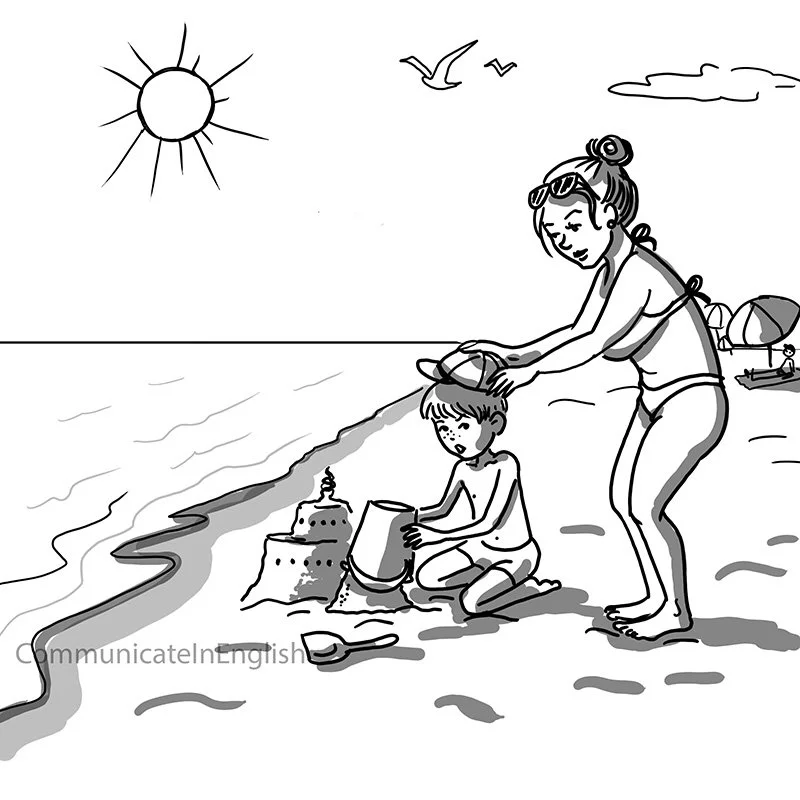
You might think that two words written with different vowels would be pronounced differently. But in fact the words “sun” and “son” sound exactly the same in standard English pronunciation - you just have to check in the dictionary and you’ll find they’re both written in phonetics like this: /sʌn/. This is because the letter “O” isn’t always pronounced in the same way, as we can see for example with the words “clock”, “phone” and “come”. The “O” in “son” is pronounced like the one in “come”. There are other words like this too: cover, mother, love, recovery, above. In all of these words the “O” is pronounced as /ʌ/. So how can we understand if we’re talking about “sun” or “son”? Don’t worry, it’s generally clear from the context.
How to pronounce TH, voiced and unvoiced
The TH sound is one of the most difficult sounds to pronounce, not only for Italians but also for some native speakers - to make it you have to put the tip of the tongue between your front teeth. It can be pronounced with no voice, as in the words “think” and “truth” or with voice, as in “mother” and “than”. Laura from Smashing English shows us how to do it.
How do you pronounce “water”?
It depends on where you’re from! English actress Emily Blunt shows us how even in a family of native English speakers words can be pronounced very differently, with her daughter choosing between the pronunciation of her English mother and her American father.
Pronouncing British place names
Lucy from English with Lucy helps us to understand the eccentric pronunciation of British place names, that are often pronounced very differently from how they’re written.
To be or not to be
Where do you put the accent, or “stress” as we call it in English, in a phrase? On a word that’s important for the meaning? OR on a connecting word? There are many different opinions…and no definitive answer…
Forrest Gump’s accent with Tom Hanks
Tom Hanks explains how he learned the accent for Forrest Gump from the actor who played the character as a child, Michael Connor Humphreys. It’s interesting that one of the characteristics of the boy’s accent is something that Italians tend to do - the hard G at the end of words ending in “ing”.
Rhythm in spoken English
One of the things about English that make it so difficult to understand is the rhythm - some sounds are strongly accented and some are so weak that they’re difficult to hear. In this video Dr Geoff Lindsay talks about weak forms in English - those syllables with no identity that are written with various different letters but aren’t pronounced as you might expect.