A bit of English every day
Welcome to my English learning support space! Here you’ll find some written explanations, as well as videos to help you become familiar with the sound of English from all around the world. Some of them are about learning the English language, but you can also find videos about traveling, cooking, music and many other topics. You’ll find shorts, reels, and longer videos so you can choose the format you like best. Just make sure you have your computer or phone settings on English in the language section! Learning to communicate in English with confidence can be a challenge, but there’s a secret to making it easier: put a little bit of English into your everyday life.
False friends: journey
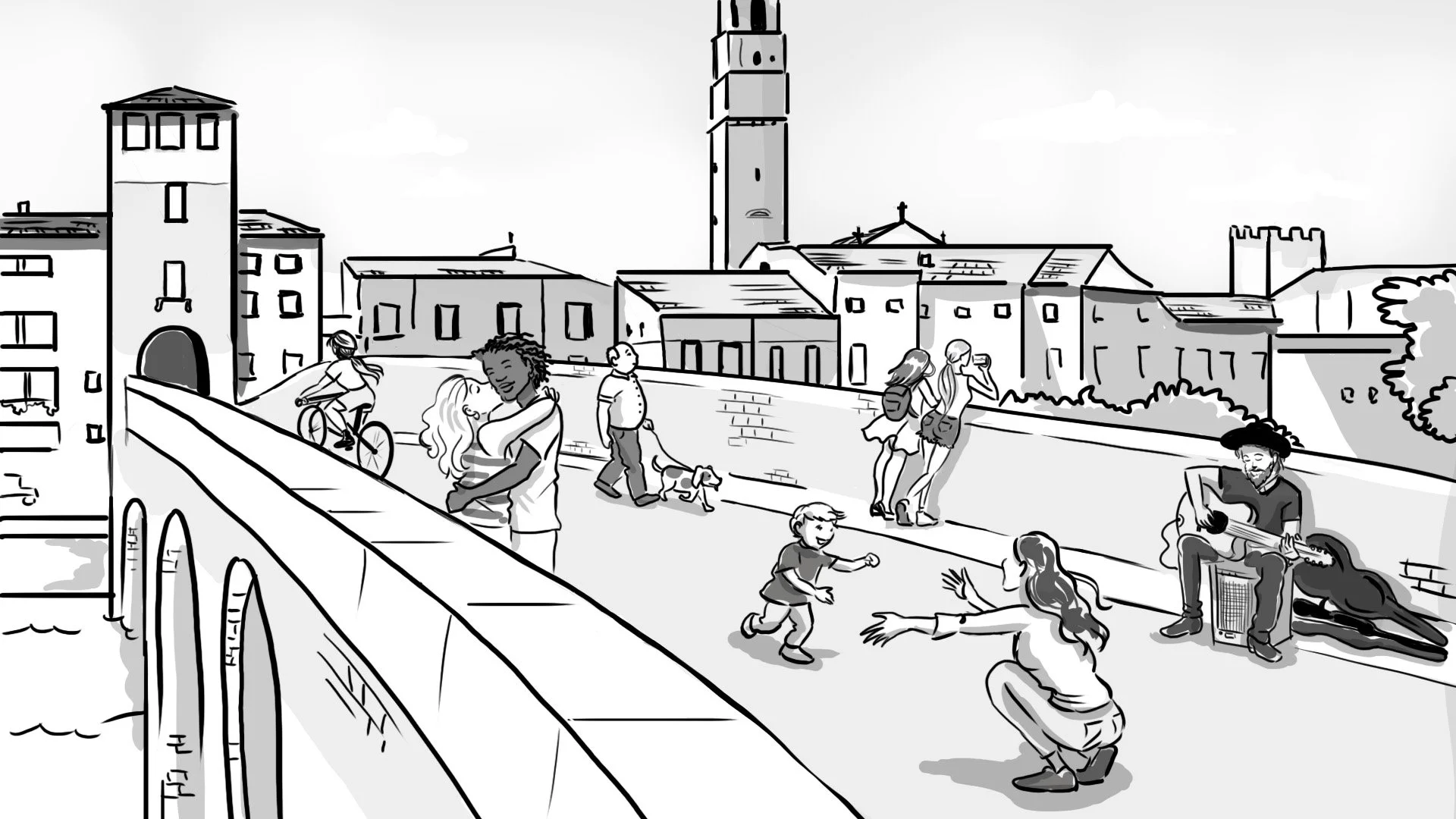
The English word “journey” sounds quite like the Italian word “giorno” and it probably comes from the same root…perhaps in the past it referred to a day trip. But in fact “journey” means “viaggio”, in the literal sense of traveling but also in a more figurative sense to talk about a “percorso” of personal development or progress through life. It often has a more poetical or philosophical connotation than the more prosaic word “trip” which we generally use to talk about single episodes of travel, but it’s also used to focus on the act of traveling itself, especially when we refer to the time it takes to go from one place to another. We don’t generally say “a travel” as the word “travel” is uncountable, although strangely it can become plural to talk about a long experience of traveling to different places, for example “In my travels I’ve seen many interesting places”.

False friends: attend
It’s back to school time, so it’s fitting that our first false friend after the holidays has to do with school. Attend sounds like “attendere”, but it’s actually more like “frequentare”. You can attend an educational institution like a school or a university; however you can also attend a meeting. So we could say that to attend means to be formally present at an organized activity There will probably be some waiting involved, but it’s not the main action.

Foto di Jon Torres su Unsplash
False friends: recovery
The English word recovery does sound like the Italian word “ricovero” but it’s actually something quite different. If you wish someone a “speedy recovery” you’re not hoping that they’ll be quickly admitted into hospital, but that they’ll soon feel better and return to a state of good health. So it is connected with health, and could be translated as “guarigione”. It can be used not only for people but also for ecosystems such as burnt forests, or even for economic situations, in which case it would be “ripresa” or “recupero”.

Foto di Christian Bass su Unsplash
False friends: pavement
The English word pavement sounds like “pavimento”, which is generally translated as “floor”. A pavement is a kind of outdoor floor paved with tiles or cement, or in Italy even with marble, and it’s often between the road and the buildings in a town or city. It’s also called a footpath, and in fact in Italian it’s generally translated as “marciapiede”. A pavement is often wider than a footpath though, and on it you can find the tables, chairs and umbrellas of a café, which in Italy is called a “bar” even if it’s primary function is providing coffee.

Foto di Gordon Chaffin su Unsplash
False friends: toast and marmalade
Today we have two false friends because they’re often found together. The English word marmalade sounds very similar to the Italian “marmellata”, but it actually refers only to jam made out of citrus fruits: oranges, lemons, grapefruit, cumquats, etc. “Marmellata” made out of other fruit is called jam, or jelly if all the solid parts of the fruit have been strained out. Jam, jelly and marmalade are generally eaten on toast, which is not what Italians call “toast”, but what they call “pane tostato”, usually with butter as well. If you find “toast” on a menu in Italy it generally means a toasted sandwich with ham and cheese inside, which wouldn’t taste very good with marmalade.

Foto di Calum Lewis su Unsplash
What do you do?
One of the first questions we ask a person we’ve just met is “What do you do?” It’s taken for granted that we’re speaking about their occupation in general, and therefore that this question is different from the more specific “What are you doing?”
The present simple is called “simple” precisely because it gives only the minimum information that the situation is in the present, and doesn’t generally refer to specific, dynamic or changing situations. This is a bit different from Italian, which doesn’t limit “il presente” with the adjective “semplice”, making it possible to use it in many cases where other forms are preferred in English because they give more information.
We can see these two functions if we compare a general, stable situation with a temporary, dynamic one:

“What do you do?” “I’m a truck driver.”
This is the usual, general activity of the speaker.
“What are you doing?” “I’m having lunch.”
This is a specific action in progress at the moment.
He habitually drives a truck, because it’s his job. But we hope he’s not driving it at the moment, because if he is he could be a danger to other drivers as well as to himself.
False friends: vacancy
It would be reasonable to think that the English word vacancy has something to do with the Italian word “vacanza”, especially when you see it on a hotel sign. But in fact it’s connected with the Italian word “vacante”, so if you see a hotel sign that says “No vacancy” it means there are no rooms available there. The other context in which you’ll see it is in the job-seeking world - a job vacancy is an opportunity to apply for a job. So if your vacation (or holiday) consists of a road trip and you haven’t booked your accommodation in advance, you hope to find the sign “Vacancy” when you arrive at a hotel or motel.

Foto di KEEM IBARRA su Unsplash
False friends: baby
Today’s false friend is baby. Babies are “bambini” but not all “bambini” are babies, only the very little ones that can’t walk yet. The slightly bigger ones that are starting to walk are called toddlers, because to “toddle” is to walk with short uncertain steps as little children do who are learning to walk. So if we want to talk about “bambini” in general we use the word children, or more colloquially kids. However, not all children are “bambini”, because if you talk about your “figli” they continue to be your children even after they’ve grown up and become adults. This applies only to the plural form though - a child is always a minor and if you want to talk about your offspring in the singular you refer to your son or your daughter. If you say “my sons” people will understand that you have only male children and no daughters. By the way, the original meaning of kids is “capretti”, probably because baby goats are playful and mischievous just as children are.

Foto di Filip Mroz su Unsplash
Ecosystem engineers in nature
The Ealing Project is an example of how the restoration of nature can solve practical problems in a metropolis like London with the help of a seemingly destructive animal like the beaver. Perhaps coexistence is not only possible but advantageous for both the natural world and human activity, as in this virtuous example in such a delicate and fundamental question as water management.
False friends: mansion
The English word “mansion” might seem to have something to do with the world of work, like the Italian word “mansione” that refers to the tasks or duties of your job. But it actually means a very large, imposing house, often in the country and with extensive grounds and gardens. This kind of grand, rich house can also be called a villa, because strangely in this case it isn’t a false friend and has the same meaning in Italian.

Foto di Nick Romanov su Unsplash
False Friends: actually
We made it to Friday, which means it’s time for our false friend of the week. This week’s word is actually. It does not mean attualmente, but in realtà, which is why the title of the film “Love actually” is “L’amore davvero” and not “L’amore in questo momento”. If you want to say attualmente in English you can use currently in more formal or business settings, or at the moment if you’re just having a normal conversation. You can use in this moment if you want to be very precise, for example “In this moment we are flying over the Taj Mahal”. But actually, we often use actually in casual conversations, to point something out or to contradict someone without actually appearing to.

Electrostatic micro current and vocabulary structures
This is a nice listening text for anyone preparing a Cambridge exam - mathematician Dr Hannah Fry explains why your laptop sometimes feels like it’s buzzing when you charge it using some vocabulary structures that you might recognize from the exam preparation. Look out for the following:
Phrasal verbs: make up; turn down; come out; let go.
Phrases and collocations: way too small; absolutely no idea; send a message; by the way; back and forth.
Word patterns: pump into; leak into; pulse through; drag across.
So instead of studying from a boring textbook you can learn about electrostatic micro current and improve your English at the same time.
False Friends: annoying
Welcome to the new weekly segment of the blog! Everyone knows that there are some English words that sound reassuringly similar to Italian words but have a different meaning, sometimes leading to embarrassing misunderstandings. As English and Italian have roots in common, these words probably started out with the same or similar meanings but evolved over time as they moved from one place to another, as all languages tend to do. Today’s word is “annoying”. This does not mean “noioso” as you might think, but “irritante”. It is annoying if your boss schedules a boring meeting at 5 pm on a Friday, when you just want to go home and start your weekend.

Hedgehog highways with David Attenborough
The legendary naturalist shows that it’s not necessary to go to wild places to find wild animals - and how even a metropolis like London can become more environmentally friendly.
Why are there so many words in English?
One of the challenges for people learning English is that there are so many different ways to say the same thing, but this can also be an advantage because if you can’t remember one word you can use another one. This is because Great Britain was governed by various different ethnic groups in its history, and English is a kind of melting pot of their different languages. Celts, Romans, Anglo-Saxons, Vikings and Normans succeeded each other for control of the country up to the Middle Ages, when the first books were written in English - including Geoffrey Chaucer’s famous Canterbury Tales which many Italians have to study at school. So for example don’t worry if you can’t remember an Anglo-Saxon word like “cheap” because you can use the Latin-based “economical” which means the same thing.
Tips for building your first gaming PC
This one is for the techies out there! Zach looks at the issue of price vs performance from the points of view of both a gamer and a dad.
@zachstechturf Follow your dreams, but don’t let an expensive gaming PC get in your way. 🫡 #PCBuild #GamingPC #PCBuilding #CompetitiveGaming #PCGaming
♬ original sound - Zach's Tech Turf
Sun and son - are they the same?
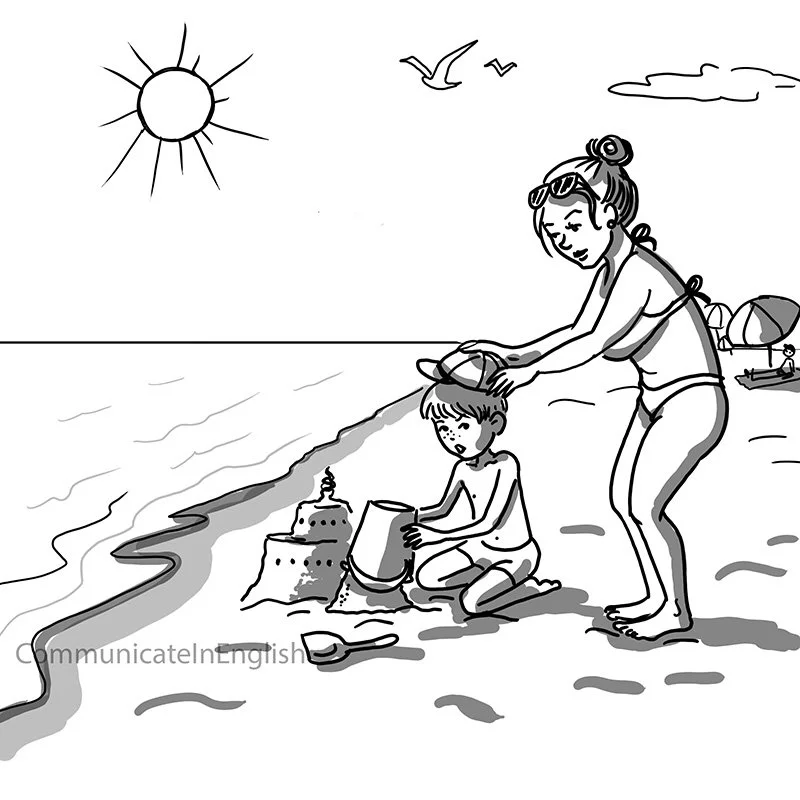
You might think that two words written with different vowels would be pronounced differently. But in fact the words “sun” and “son” sound exactly the same in standard English pronunciation - you just have to check in the dictionary and you’ll find they’re both written in phonetics like this: /sʌn/. This is because the letter “O” isn’t always pronounced in the same way, as we can see for example with the words “clock”, “phone” and “come”. The “O” in “son” is pronounced like the one in “come”. There are other words like this too: cover, mother, love, recovery, above. In all of these words the “O” is pronounced as /ʌ/. So how can we understand if we’re talking about “sun” or “son”? Don’t worry, it’s generally clear from the context.
The days of the week
It’s not easy to learn the days of the week in English even for native speakers - there are songs and nursery rhymes to help children memorize them and this strategy can help adults too. Perhaps the worst problem is the similarity of the names “Tuesday” and “Thursday”, but the strange spelling of “Wednesday” is a problem too, as it’s pronounced “wensday”. And of course it’s not “venerdì” as it might sound but “mercoledì”. A song like The Cure’s “Friday I’m in Love” could be a nice substitute for the classic “days of the week” songs for kids.
What’s the right answer to “How do you do?”
William Hansen tells us how to answer if we hear this mysterious English expression, which could seem to be similar to “How are you?”